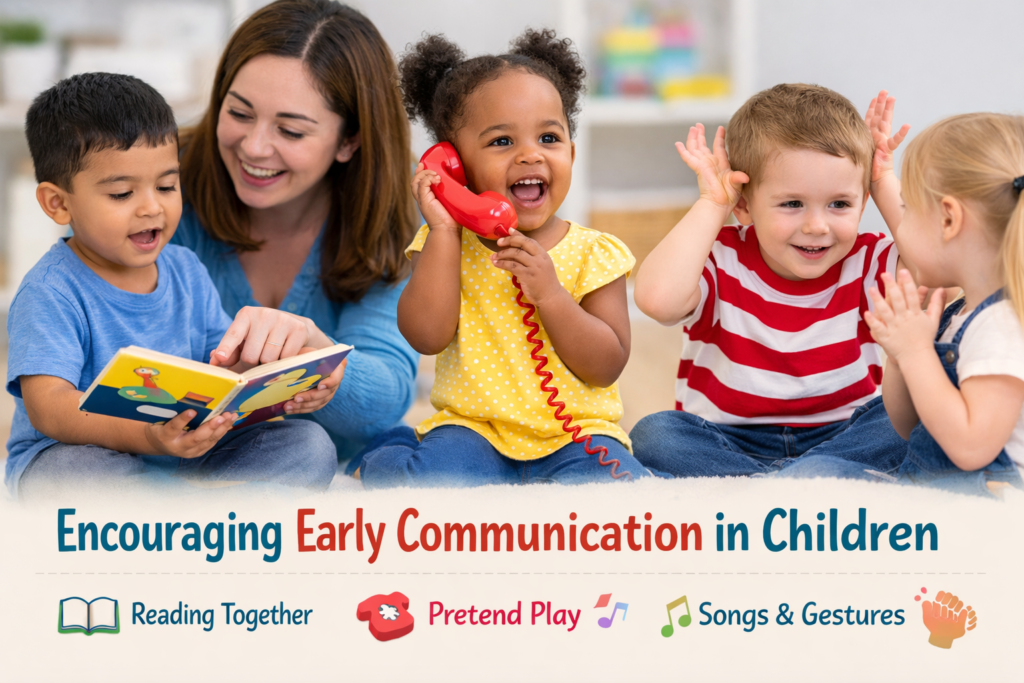
For most of us, our first memory about our child must be their cry when they entered this world. That cry was their way of communicating to us that they have arrived. Crying is one of the very first ways through which babies learn to communicate. Then slowly they learn that there are more ways to communicate than crying. Through smiles, babbles, sounds, words, expressions, gestures, and eventually through sentences, a child learns different
ways to communicate more and more effectively with people around them.
When a baby cries, we pick them up, feed them, comfort them, or change their nappy. By doing so we respond to their cries. This way they begin to understand that there is a response to their crying, and this way they learn to communicate their needs through cry.
Most of us mothers will be able to recall how we could tell if our baby was crying because of hunger, pain, or sleep, as they usually have different cry patterns for different needs—also called differential cry. Most communication that happens in the initial days of a baby’s life is preintentional or unintentional. The baby in this stage has not made the association between his cry, sounds, or actions and the response he receives. Later, as they start making these associations, these movements, sounds, and expressions become more intentional. They start using them to achieve something. So, when a baby’s attempt to communicate receives a desired response, that action gets reinforced.
Babies get a lot of information about words and talking from us by watching and listening to us talk. They understand the basics of communication by making associations between a sound, action, or word and the response it receives. For example, a baby quickly makes the association between the word “bye” and going out, or “wearing shoe” and going out. Through these associations, babies
begin to first understand language and then slowly start usinglanguage to communicate with others.
This means, as parents, we get a lot of opportunities to encourage and reinforce their actions, sounds, and speech. This way we can
also help them learn to understand and use different means of communication.
Let’s look at a few strategies that help encourage early communication in babies and toddlers:
1. Maintaining Eye Contact and Going Face to Face with the Child:
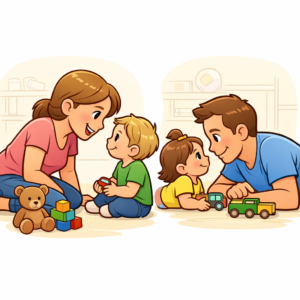
This is very important. When we have good eye contact while interacting with someone, it means that we are interested in what they are saying and we are paying attention to it. The same is true for going face to face. It allows the child to understand that you are interested in what they want to share.
Going face to face and establishing eye contact also helps the child watch and learn how we say different sounds and words, observe our facial expressions, gestures, etc. So next time your child pulls you down to play with them, kneel down or get down to your child’s level and play alongside.
2. Imitation:
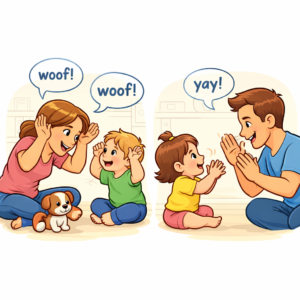
When we copy the sounds and actions of our child, we’re showing them that we have paid attention to what they did and that we are interested in it. This is very encouraging for the child and in turn encourages them to imitate back what we do or say. We can also use imitation to add more words to the child’s utterances or add new ideas.
3. Labelling:
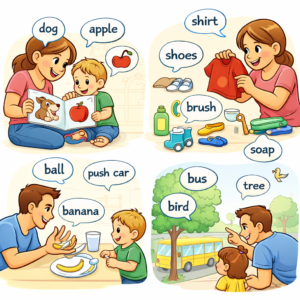
Labelling means naming. By using names/labels, we can help our children make the association between a word and an object or an action. We can do this by labelling:
• Objects and/or people that the child is interested in.
• Things that the child is doing (action words or verbs).
It is important to focus on words that are more functional (useful) for the child in day-to-day situations.
Few other activities that can help children with understanding names/labels of objects are:
• Naming during daily routines:
While getting the child ready, name objects as you use them. For example, “shirt”, “shoes”, “brush”, “soap”.
• During play:
If the child is playing with toys, label the toys or actions. For example, “car”, “ball”, “doll”, “push car”, “throw ball”.
• Looking at picture books:
Point to pictures and name them. For example, “dog”, “apple”, “baby”, “bus”.
• Snack or meal time:
Name the food items the child is eating. For example, “banana”, “milk”, “rice”, “water”.
• Outdoor activities:
When going out, label things the child notices. For example, “dog”, “bus”, “tree”, “bird”.
Remember, repetition in natural situations helps the child gradually understand and associate words with objects and actions.
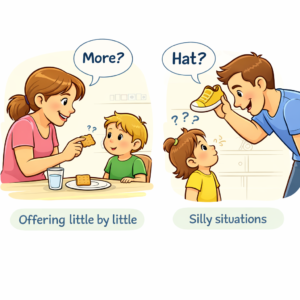
4. Creating a Reason for the Child to Communicate:
If all of their needs are taken care of without having to ask, if there is no need for the child to ask, reject something, or ask for more, then there is no reason for the child to communicate. Therefore, it is important to create situations that will encourage the child to communicate or initiate an interaction.
Some ways to achieve this are:
• By offering objects little by little.
• Creating unusual or silly situations that the child does not expect, and then waiting for a response.
5. Offering a Choice:
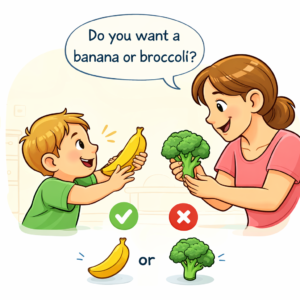
This is another powerful way to encourage communication. Children may find it overwhelming to answer a question when there are endless options. Giving a choice gives them power to choose without making it too overwhelming, thereby encouraging communication.
Initially, start with two objects—one that is highly preferred by the child and one that is disliked. This will make it easy for the child to make a decision, and the urge to communicate this decision will be stronger. Give time for the child to make the choice. The child may express choice through pointing, looking, reaching, sounds, or words. Make sure to give only the object that was asked for and always name/label the item aloud before giving it to the child.
6. Modelling:
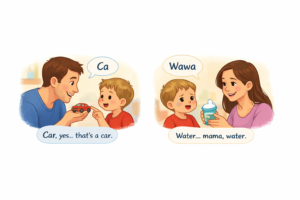
Modelling refers to the technique of saying words, phrases, or sentences that you want the child to say or what you think your child wants to say. Here, we do not correct the child or ask them to repeat what we say. We give a good, clear model of how every word should sound but without pointing out mistakes.
For example, if a child says “ca,” say “car, yes that’s a car.” Or if a child says “wawa,” say “water, mama water,” interpreting that the child wants water.
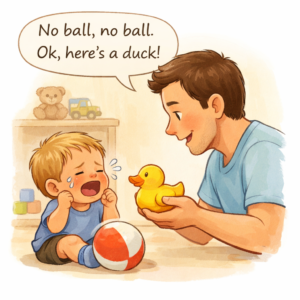
Or during playtime, if a child cries and screams when you pick up a toy (ball), interpret that they don’t want to play
with it now and say “no, no ball,” then try offering another toy.
7. Use More Comments and Avoid Questions:
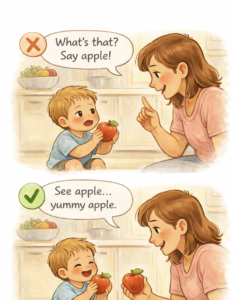
None of us like to answer questions all the time. This holds true for children as well. Parents often ask many questions because they want to test if their child knows a word. Instead of asking a question, try turning it into a comment.
For example, when you see an apple, instead of asking “What’s that?” or “Say apple,” you may say, “See apple, yummy apple.” Or instead of asking “Do you want to open the door?” you could say, “Let’s open the door.” When we ask too many questions, we do not give children enough opportunities to imitate words. Ask questions only when you need to get information, and avoid using them to test the child.
8. Turn Taking:
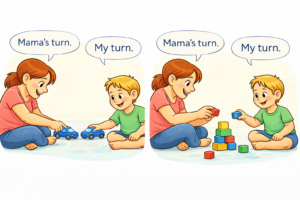
Communication is an exchange of information between two or more people. It involves taking turns to talk and waiting for your turn while letting the other person talk. Therefore, learning turn-taking is important to understand the rules of communication. Children initially learn to take turns through play and later understand taking turns while talking.
Pushing cars back and forth, taking turns to put blocks or shapes in a sorter are good activities for teaching turn-taking. You could also label the turns from the child’s perspective, e.g., “my turn, mamma’s turn.” Remember to take your turns quickly to maintain the child’s interest.
9. Book Reading:
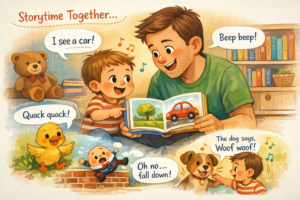
Reading books together is a huge opportunity to introduce a wide variety of new words and ideas. It is also great bonding time which improves communication. A few things to focus on during book reading:
• Let the child pick the book of their choice.
• Sit in front of the child and hold the book facing them.
• Use a book with lots of pictures.
• Allow enough time to look at the pictures.
• Name the pictures and wait to see if the child wants to add something. For example, say “I see a car,” and then wait to see if the child wants to comment.
• Use simple words and sentences to describe pictures/stories.
• Try leaving some familiar or favorite bits for the child to fill in, e.g., “Mother duck said ________.”
• Explain reasons and causes of events, e.g., “Humpty dumpty fell because he climbed on a wall.” This helps children make cause-and-effect associations.
• Make reading interesting using sounds, actions, and words. (You can also find a few good books in the toys recommendation page.)
10. Narrating Daily Activities:
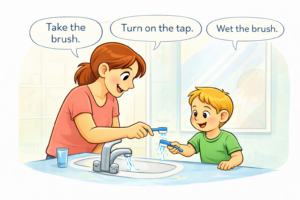
Daily activities provide great opportunities to improve interactions and encourage communication. Since these activities occur consistently and follow the same pattern every time, they provide many chances to repeat key words including different actions and objects. Familiar routines also help children take turns as they know what’s coming next.
A few tips on narrating daily activities:
• Narrate whatever you are doing, even if the child is not responding. For example, when brushing teeth, say, “First let’s take the brush, next let’s turn on the tap, then wet the brush,” and so on.
• Label every action and object, and repeat key words.
• Pause and give time for the child to say or do something.
• Allow your child to take turns or make a choice (e.g., picking their dress).
You may also find our article on visual scheduling helpful in supporting daily routines.
A Few Things to Remember:
– Responding to Attempts to Communicate:
Every time a child makes an attempt to communicate—sounds,gestures, expressions—acknowledge it. For example, if they put their arms out, ask “You want up? Come to mamma?” and then pick them up. Responding immediately helps children understand their
efforts matter and encourages continued development.
– Use Simple Language:
Use short sentences tailored to the child’s current communication level. For example, if offering a cookie, say “cookie?” to a child not
yet using words, “want cookies” to a child using single words, and “want some cookies” to a child using phrases.
– Repetition is Crucial:
Create many opportunities to repeat important words in different situations. Children may need to hear a word many times before
understanding and using it. For example, if “apple” is the target, repeat “apple” in play often: “Red apple,” “Juicy apple,” “Drink apple
juice,” “Let’s cut the apple,” “Give apple,” and so forth.
– Wait for a Response:
Give your child time to respond. After saying a word or phrase, pause for 5 to 10 seconds to see if they want to react, with a word
or gesture. If not, you can complete the sentence. For example, when playing with an apple, you can say “Cut the ___,” wait, then
say “Cut the apple” if no response.
– Be Enthusiastic and Join Their Play:
Sometimes we think children are not interested in playing with us, but that may not be true. Observe your child and find what they like. Join them with a similar toy, imitate their actions, and show how to play if needed. For example, if your child bangs a comb on the floor, sit next to them and pretend to comb a doll’s hair or your hair. Make it fun and use facial expressions, gestures, and an excited voice to keep their attention.
Conclusion
Parents are the most important teachers for our children. By incorporating the strategies above, we use everyday interactions to encourage and improve communication. Most of the strategies do not force children to speak or communicate but provide good models using simple words, taking turns, and allowing them time to imitate and respond by joining them in activities they enjoy. Remember to enjoy this interaction, keep it fun and exciting by being silly and entertaining. Creating warm and enjoyable moments will help improve your baby’s language and communication skills.