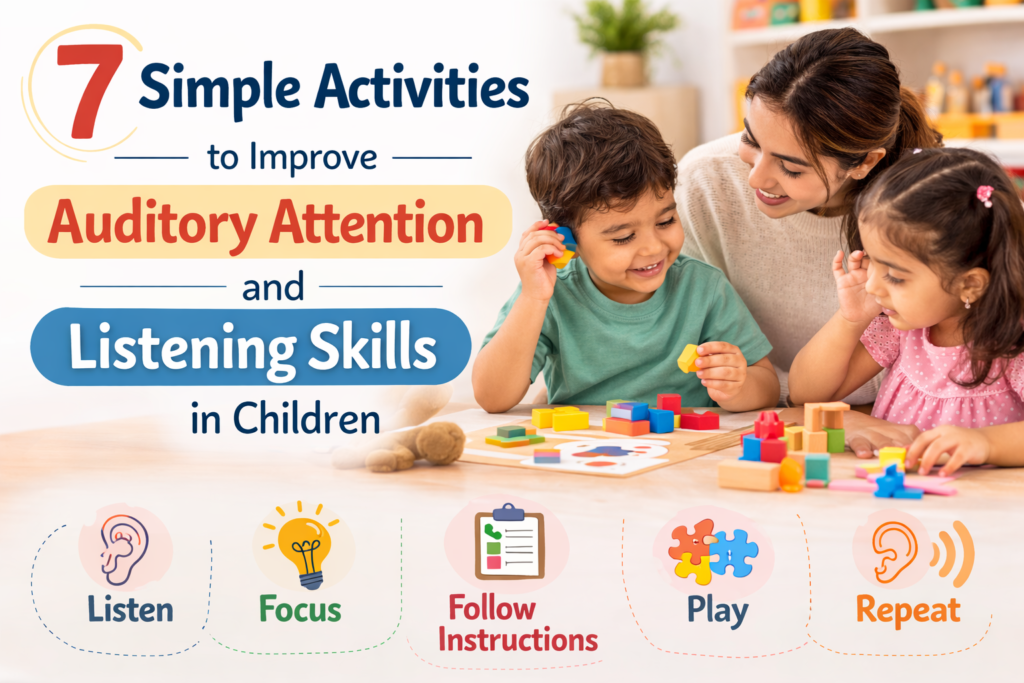
Children learn to speak by listening first, which is why improving auditory attention can support speech and language development. Hence improving attention must be one of the most common and, in fact, the initial goals that are identified for most of the kids who attend a speech therapy session.
So, what is attention, why is it important for speech and language, and what are some of the ways through which we can work on improving attention? That’s what we are going to discuss in this blog.
What is attention?
Attention is the mental ability to choose and focus on what’s relevant by effectively filtering out irrelevant information. The world around us is like an ocean of information or stimuli. If we didn’t know how to pick just one stimulus and focus on it, we would be lost.
For example, for you to respond to someone who calls your name while you are walking in the park, you should be able to filter out other noises (birds, dogs barking, other people talking) and pick up just what’s relevant to you. This is a very complicated process and involves many components.
For the time being, let us bring our attention to a very important component, “auditory attention,” which is the ability to focus on auditory stimuli. This plays a very important role in how an individual hears sound and how he or she is able to interpret sounds and language.
As we may expect, there have been many studies which have established a direct link between attention to speech and language development. For a child to develop language, he/she should be able to pick and select meaningful signals from the wide range of stimuli that are present around him/her. For this, he/she should learn to pay attention to speech or language.
Let’s look at some activities that can help improve auditory attention
These activities can be used with children who have general difficulty in following instructions.
- Simon Says
This is one of the favourites among children. Here the child has to follow instructions given by Simon (Parent, Therapist, Sibling). Simon stands in front of the child and gives commands like “Simon says clap your hands” or “Jump.”
The child simply has to follow it. It’s an activity that kids love.
Remember to always start with single-step instructions and then slowly progress to multiple steps.
Example: Start with “Simon says give ball.”
Then once the child is comfortable with one target word, go to the next level with two targets: “Put ball in the box.”
Next step, as the child learns to comfortably follow two-step instructions, you can go further and say: “Put the red ball in the box.”
2. Finding the error/mistake
This is another favourite as kids also love to find and correct our mistakes. Here you can sing or recite a familiar song or poem by changing a word or phrase.
Example:
“Baba black wolf, have you any wool?”
“Twinkle Twinkle mummy star.”
Start with very obvious mistakes and then slowly make it more complex by replacing rhyming words (Twinkle twinkle little car) or by changing the word order.
3. Identifying the sound
Keep a few items in front of the child like a whistle, a sharpener, a candy wrapper, etc.
First talk through the items that are kept before the child. Then ask him/her to close his/her eyes and identify the object you are using to make the sound.
Again the complexity of the activity can be increased by not having these items laid out in front of the child.
4. Guessing the picture
Have a few flashcards in a bag. The child has to listen to the word/item that the clinician says and find its picture from the flashcards.
Having more flashcards to choose from increases the complexity of the task.
One thing to remember while doing this activity is to choose objects that the child already knows. Otherwise he/she will not be able to choose the right one even if they are paying attention. This could demotivate the child.
5. Checking comprehension
Read a story and ask questions to see if the child was able to follow.
With smaller kids, try to use a picture book as visual cues will help in recalling information.
6. Following instructions
Start with following single-step instructions, then progress to more targets as 70–80% accuracy is achieved for each step.

Example for single-step instructions:
- Color apple
- Color sun
- Color ears
- Color flower
- Color feet
Example for two-step instructions
- Color apple red
- Color water and flower (not specifying color)
- Color two legs
- Color grass green
- Color sun and jelly
Example for three-step instructions
- Color apple and flower red
- Color tree and grass green
- Circle flower and sun with red color
- Circle two eyes and nose
Example for four-step instructions
- Circle apple and color sun
- Color water green and flower red
- Cross ears and put a tick on nose
Note that we are targeting only one key word in the first step and as the child is able to follow it at least half of the time, we can proceed to the next level.
It is important to first describe the picture that is used and check if the child knows/understands the items in the picture. If the child doesn’t know what an apple is, you cannot expect him/her to color or circle it.
Here the child is unable to follow steps not because of attention difficulty but because of limitation in vocabulary.
You can also use commands like circle, tick, cross instead of color, but make sure to teach the child to circle, cross and tick before giving commands.
This will be a great help for them to understand instructions at school better as these are some of the common commands used in school.
7. Following instructions through art and craft activity
Have the materials required ready in front of the child (colored papers, scissors, glue, chart paper).
Give instructions in steps depending on the child’s level of understanding.
Example:
First level:
Take red paper, give glue.
Next level:
Take glue and stick the flower.
Cut red flower.
Then:
Cut red and yellow flower.
Cut red flower and green leaf.
Last:
Cut red flower, green leaf and stick them.
Few things in general to remember while working on improving attention
• Choose comfortable seating with minimum distractions.
• You may use prompts to grab attention before starting each activity, like pointing to the ear and saying “listen.”
• Use simple language.
• Encourage the child to ask for repetitions if needed by raising their hand and saying “Can you please repeat?” This will be a very helpful skill for school.
• You may also ask the child to repeat the instruction to check if they have understood.
• Most importantly, give them time to respond.
Attention is a very important cognitive ability that is a prerequisite for speech and language development and also for learning any new skill. It is therefore very important to incorporate these activities into your home therapy plan.
It can also be incorporated into day-to-day activities like sorting clothes of different family members or through art and craft activities.
Try to make the activities interesting as it will automatically help increase attention.
Another important thing to remember is to use age-appropriate items and activities. Also don’t hesitate to repeat activities as success in a task improves the confidence of the child, which in itself is a big motivator.
Improving attention will have a positive impact on language, literacy, and in general an improvement in the child’s day-to-day activities.
Practicing these listening activities regularly can help children improve their ability to follow instructions, focus on speech, and develop stronger communication skills. Just make sure to keep it a fun experience for both of you.
Good luck!