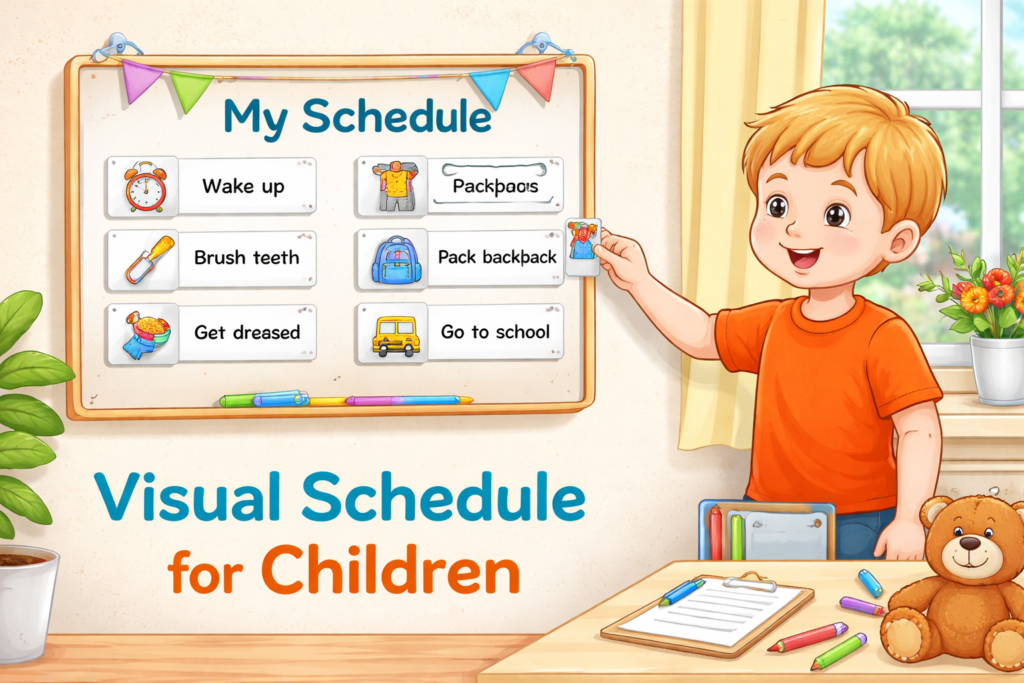
Visual schedules help children understand daily routines, reduce anxiety, and become more independent by showing what to expect next.
In our daily busy schedules, we know one of the biggest challenges every mother faces on a day-to-day basis must be deciding what to cook. Most of us would have made meal plans for the week and realised how it makes our lives much less stressful and more efficient. Similarly, having our daily tasks written down in a planner helps many of us work more efficiently. This is because, by doing this, we are aware of what to expect from the day and are much better prepared to face it.
Visual scheduling is the process of using graphic representations to schedule and communicate activities and tasks. In simpler words, we use a sequence of pictures, photos, symbols, text, or any visual format to help someone understand what he/she is expected to do. Visual schedules help in separating tasks that are part of a routine. They help teach new skills by breaking down a single activity into a number of smaller steps. Using a visual schedule also helps improve independence during the target activity.
Who is it for?
Visual schedules can be helpful for most of us, as discussed, but many studies have concluded that visual schedules are especially helpful for individuals with autism. However, visual schedules can be helpful for all children, especially those who benefit from structure and visual learning. We have a lot of research evidence supporting that individuals with autism may be able to understand information better when it is presented visually, especially when it is broken down in a step-by-step manner. They often have difficulty paying attention to auditory information and understanding it.
So, in general, visual schedules will work well for anyone who prefers visually presented information over auditory information. This can immensely help children who have difficulty understanding, processing, and remembering verbal directions. This will also be helpful for children who have difficulty coping with unstructured activities by providing them with more structure and predictability.
Types of Visual Schedules
Visual schedules can be made in different ways. A few common ones are:
· Using real objects: You can place real objects in a sequence
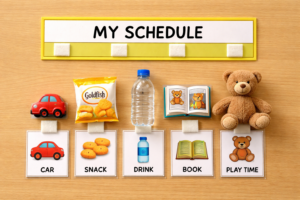
· Using pictures: A visual schedule is made by placing pictures in the desired sequence
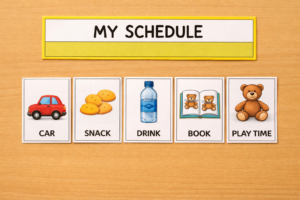
· Using photos: Actual photos are used
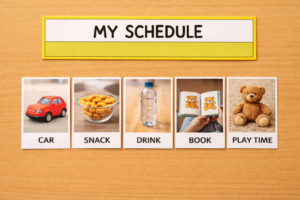
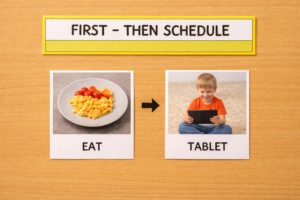
· Using first-then schedules: Two pictures are used, one followed by the other.
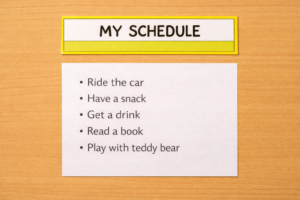
· Using written schedules: For adults who can read or for higher-functioning children who prefer written text.
How can these be used?
A) To help the child understand and follow daily routines better
Having the activity clearly planned out in sequence helps improve the understanding and cooperation of the child. This further helps increase participation and also encourages independence. Having structure helps the child anticipate what is going to happen next and prepare better for it. This, in turn, helps reduce anxiety. Using these can also reduce the need for repeated verbal prompting.
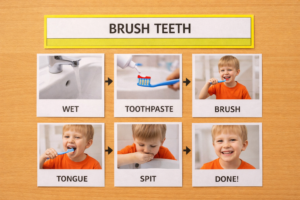
For example, an activity like brushing teeth can be broken down into different sequential steps, thereby helping the child understand and plan the activity better. This will help improve independence. It also reduces the need for repeated verbal reminders, reducing frustration for both parents and the child. It can also help the child understand that a step they don’t enjoy e.g., cleaning the tongue is not going to last forever. It helps them understand that they can complete it and move on to the next step, thereby reducing anxiety.
B) To prepare children better for transitions between activities and/or places
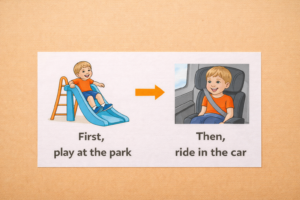
Transitions can often be difficult for children, especially when they have to stop a preferred activity and move to something else. Using a visual schedule helps the child understand what is happening next, making the transition smoother. It gives a clear expectation and reduces anxiety by preparing the child in advance.
For example, showing a visual like “First play → Then go in the car” helps the child understand what to expect and makes it easier to shift from one activity to another.
C) To prepare the child for an unexpected event or a change in the routine
Using visual schedules can communicate what changes should be expected during the activity. This will help the child anticipate and prepare better for the change.
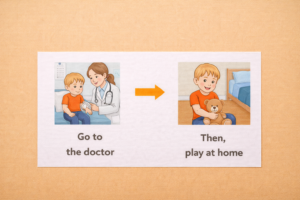
For example, if the child has to go to the doctor for dressing a wound, which can be an unexpected and anxious event.

D) To communicate to the child what they can expect after an event or change
Some tips on how to create an effective visual schedule
- Identify a routine or skill that you want to target. Think of a routine or skill that is most difficult or stressful.
- Break down the task into simple smaller steps that can be easily understood. If you notice that the child is having difficulty following and mastering any specific step, then consider simplifying it further.e.g., In the morning routine (shown in the above picture), if the child has difficulty getting dressed for school, break it down into smaller steps like in the example shown below. Image
- Decide the length of the schedule. You may choose to use a longer schedule covering the entire day (e.g., wake up, breakfast, school time, lunch, play time, bathing, story time, nap time) or different shorter schedules for specific activities like brushing, bathing, etc. Choose what is appropriate for the child.
- Choose an appropriate visual format (horizontal, vertical, etc.). Also decide on the type of representation like pictures, line drawings, or photos. Consider size and colour if necessary. You can download pictures from websites like DO2Learn. You can also personalise it by using pictures of the child doing the activity. Remember to laminate the photos as they will be used repeatedly.
- You can also include duration or quantity (e.g., listen to songs for 15 minutes or 3 songs, or get 1 cookie). Ensure each step is represented visually.
- Teach how to follow the schedule. Most children will need verbal and physical guidance initially. This is crucial when introducing the schedule. As the child learns, you can gradually reduce support.
- Some resistance can be expected, especially if the activity is challenging. It is important to focus on completing the task. You may include a preferred activity as a reward. Use plenty of praise and encourage transitioning to the next activity. Remind the child that completing the task will help them move to the next activity sooner.
- Lastly, include reinforcements or motivational components after completion. These could be treats or activities the child enjoys.
Some useful resources
Here are a few websites and apps that may help in creating visual schedules:
andnextcomesl.com
do2learn.com
visuals.autism.net
Using a visual schedule can be helpful for most children, especially those who have difficulty following verbal instructions. It provides predictability and structure by showing the sequence of events, when to stop one activity and move to another, and any changes in routine. This information makes a huge difference in reducing anxiety and meltdowns.
It also helps children become more independent by providing opportunities to learn with minimal external support. All of this together improves their understanding and confidence, making them more willing to participate in different situations and activities.
As always, I would like to remind every parent that each child is different. What works for one may not work for another. But this is definitely worth trying. So do try this when introducing a new routine or teaching a new task.
You may also find our article on auditory attention activities helpful.
Start small, be consistent, and you will slowly see your child become more confident and independent.
All the best.
Speechie Mom
Hi, this is a comment.
To get started with moderating, editing, and deleting comments, please visit the Comments screen in the dashboard.
Commenter avatars come from Gravatar.