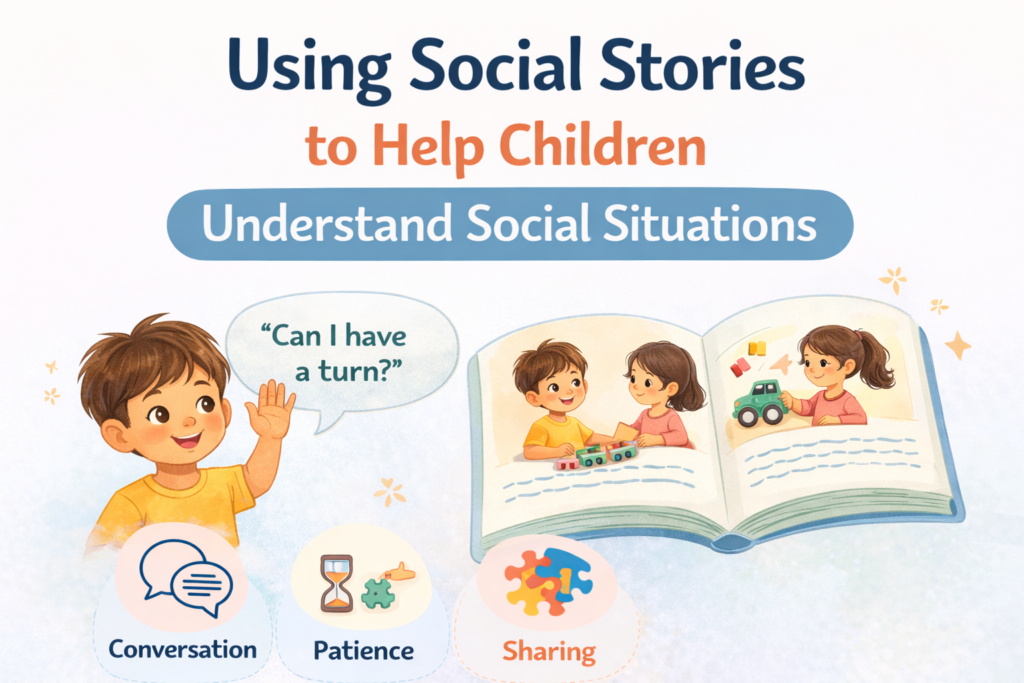
Many of us grew up listening to stories — moral stories from Amar Chitra Katha books or from our grandparents at bedtime. I still remember waiting for those bedtime stories my grandmother would tell me. We all had our favourite stories — the ones we wanted to hear again and again. Without even realising it, that repetition is one of the ways we learned language.

And almost every time at the end of each story, she would sit with us and talk about it — what happened, why it happened, and what we could learn from it.
Looking back now, I realise she was also creating stories of her own to help us understand different situations, emotions, and behaviours. She was doing it in a way that felt simple and safe.
Stories are, in fact, a very powerful way for children to learn to understand and use language.
Why Stories Are So Powerful
Through stories, children learn to:
- Understand sequence — what happens first, next, and last
- Connect events and reasons — why something happened
- Learn new words in context, not in isolation
- Build longer, meaningful sentences
- Understand feelings and perspectives
- Follow and participate in conversations through role-plays
Stories help children move from single words to connected communication.
But Stories Are Not Just About Language
Stories are not just about learning words and sentences.
Its also a powerful way to teach children about the world — what is right, what is not, how to behave, and how our actions affect others.
Instead of directly correcting a child, stories create a safe, non-judgmental space. A child can observe, think, and understand — without feeling pressured or criticised.
Through stories, children learn:
- What different situations mean
- How people might feel
- What choices can be made
- What might happen next
Stories quietly guide children towards better understanding and better decisions.
What Are Social Stories?
In therapy, we use something called social stories to do something very similar.
Social stories are short, simple, structured stories that are carefully created for a specific child and situation.
They describe what is happening, explain the situation, and guide the child towards appropriate responses.
Each social story is customised based on:
- The child’s age and understanding
- The specific situation they find difficult
- The skill they need support with
Social stories are not general lessons. They are designed to make a specific situation clearer and easier for the child therefore they can be looked as personalised supports.
They help children to:
- Understand everyday situations
- Recognise feelings (their own and others’)
- Learn what they can say or do
- Prepare for real-life interactions
Unlike direct instruction, social stories do not tell a child “don’t do this”. Instead, they show what can be done — gently and clearly.
What Do We Focus On in a Social Story?
When creating a social story, the most important thing is what we choose to highlight. It is natural to focus on what the child is doing wrong. But in a social story, we shift the focus towards what the child can do instead.
The emphasis is on the right or expected behaviour (target behaviour) —not on the mistake.
Why This Approach Matters
Many times, children already know that a behaviour is not acceptable.
They may know:
- “I should not hit”
- “I should not grab”
- “I should not shout”
But the real difficulty is this: They are not sure what to do instead.
The challenge is not just stopping a behaviour — it is learning an appropriate, acceptable replacement behaviour.
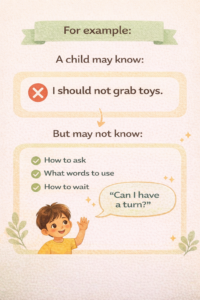
So the behaviour continues — not because they don’t understand, but because they are uncertain.
This is why social stories focus on the target behaviour.
They clearly show:
- What the child can do
- What the child can say
- What is expected in that situation
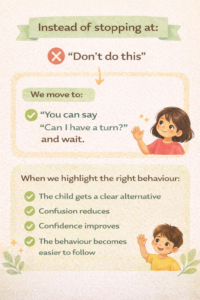
We are not just removing a behaviour — we are replacing it with something meaningful.
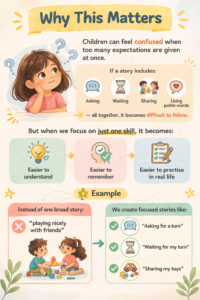
Another important consideration while creating a social story is to focus on one specific skill or situation. Instead of trying to teach many things together, we keep the story clear and focused.
One story = one target
How to Use a Social Story
A social story is most effective when it is used regularly and meaningfully, not just once.
Here are some simple ways to use it:
- Read it regularly
Read the story with the child multiple times. Repetition helps the child become familiar with the situation and the expected response.
2. Read it before the situation
You can read the story just before the actual situation happens. For example: Before the class goes out to play, you can read a story about taking turns. This helps the child feel more prepared and confident.
3. Act it out (Role Play)
This makes the story more interactive and meaningful.
Act out the story using:
- Puppets
- Toys
- Role play with the child
4. Discuss and Engage
Do not just read the story — talk about it.
You can:
- Ask simple questions: “What is happening?”
- Encourage the child to respond: “What can you say?”
- Relate it to real life: “What will you do in class?”
This helps the child actively think and connect, rather than passively listen.
Remember, we know our children the best. We know their interests, their favourite characters, what will get their attention — and we also know their challenges.
What we do through social stories is help them navigate those challenges by showing them a possible way forward.
There are a few simple things to keep in mind:
- Keep it simple and positive
- Focus on the target behaviour
- Keep the tone calm and encouraging
And always remember — the focus is not on correcting the child, it is about helping them understand what they can do instead.
You can find few simple, ready-to-use stories here.