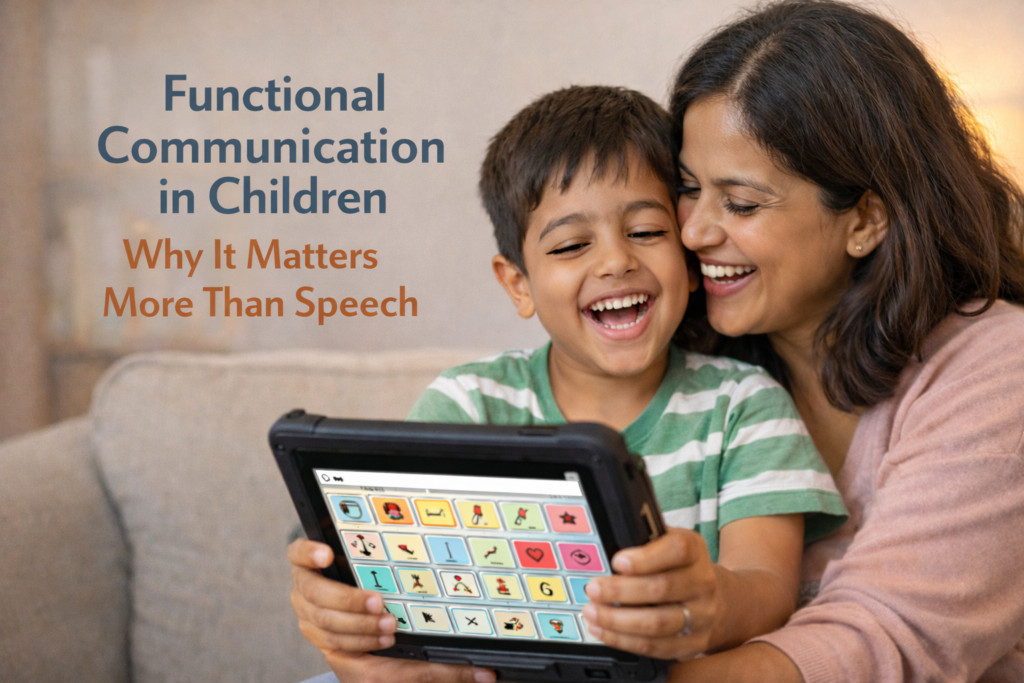
In this blog, I would like to discuss Functional Communication, a topic that I believe needs more emphasis, or rather more clarity. It is a common notion that a speech therapist is someone who can help people speak. But personally, I would be much happier if people understood that I am (in fact, all SLPs are) someone who can help a person communicate more effectively and efficiently.
Now you must be wondering if speaking and communication aren’t the same. Actually, no. Even though speaking is the most preferred way of communicating for most of us, we all communicate in many different ways. These days, most of us communicate a lot through writing (WhatsApp). Facial expressions, gestures, signs, etc., are all different means of communication that we use on a day-to-day basis.
Now let’s look at what communication is, why we have to focus more on communication, and what the different ways are by which we can improve communication.
Communication begins with connection, not just words.
Communication
Communication is the process of exchanging information or sharing a message with others. We don’t need speech for communication.
If you went to a foreign land and didn’t know the local language, you could still get a taxi and go to your hotel. How would you do that? You can use gestures, facial expressions, written notes, or even use Google Translate.

Now tell me, would you wait until you learned and mastered the language to interact with people, ask doubts, or share your thoughts? How frustrated and angry would that make you? Or would you rather use signs, gestures, facial expressions, or other means like a translator, as we said, to communicate until you learn and/or master that language? Which do you think is a better option?
The same applies to a child who is finding it difficult to communicate through spoken words or speech. Will it be right to wait for the child to learn and master speech and only then have an opportunity to communicate? Or would it be better to provide an opportunity to communicate through alternate means until the child is ready to communicate verbally?
This is very important because a lot of difficult or undesirable behaviours that we may see in a child could be stemming from their difficulty in communicating. Not being able to express needs or make denials can be very frustrating. This can account for a lot of their difficult behaviour.
Functional Communication: Why is it Important? How can it be achieved?
Our primary goal should be to help a child become capable of effectively and spontaneously communicating their needs, wants, and/or ideas. This will help the child significantly in improving his/her quality of life.
This is because, by targeting more functional communication, we are providing them with a means/mode through which they can express their needs or feelings when they want to. This will help in bringing down undesirable and difficult behaviours to a great extent.

Augmentative and Alternative Communication (AAC)
For individuals who are non-verbal, or even if they have difficulty being understood with natural speech, Augmentative and Alternative Communication (AAC) can be very helpful. AAC refers to different methods of communication that help support and/or replace speech for children or adults whose natural speech is not sufficient to meet their needs.
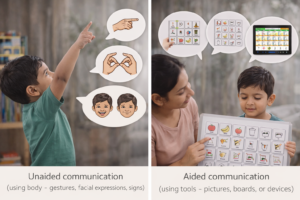
AAC is widely classified as aided and unaided.
Unaided refers to systems that don’t require anything other than our body, e.g., facial expressions, sign language, gestures, etc.
Aided systems refer to using some device or tool. This could be basic or high-tech. Basic includes using pictures, writing with a pen, or pointing to letters or words. High-tech AAC systems refer to more customizable and/or speech-generating devices with different voice and language options. In most cases, people use a combination of both.
We shall discuss the different means of AAC in detail in future blogs.
Let’s now have a look at the steps involved in this process:
Step 1: The first step is to identify the most appropriate means/mode of communication for the child. As mentioned, we will start with what the child can use comfortably and easily. It should be easy for the child to learn and use. It should also be easily understood by the adults around them.
A speech therapist can assess the child and identify the most appropriate means of communication. These could be gestures, sign language, pictures (PECS or other communication boards), electronic devices, or apps (with voice output), etc.
Step 2: The next step is choosing what to teach or identifying the target words. The word selection must be based on the child’s needs and must be highly motivating for the child. Parents play a very important role in this because it is very specific to each child.
This is a crucial step. Something that is motivating and/or important for one child may not be so for another. So identify what is most important for your child and start from there. These words should be targeted first.
Step 3: Introducing and modelling the target words. After the target words are selected, we have to show how they can be used through the selected mode of communication (sign, picture, etc.), along with modelling the word. This means we have to say the word and demonstrate how the child has to use it (sign, picture).
This has to be repeated many times. Since the target words are important for the child, you will get many opportunities throughout the day to practise this. Remember that it will require many repetitions and modelling before the child starts to say, sign, or exchange pictures. Repetition is key here. Children need to hear and watch it many times before they learn it, so you have to be very patient.
Step 4: Using temptations and reinforcers to encourage the use of these target words. After introducing the target words, create situations that encourage their use. For example, keep an object in a place that is visible but not reachable. If the child attempts to reach it or makes a move to communicate, encourage them to use sign/speech/picture by asking questions like “What do you want?” in a confused yet encouraging tone.
Give the child time to respond; waiting is key here—you may count up to 10 in your mind. If the child still doesn’t respond, model the word and give the object. Acknowledge the child’s attempt to communicate—we don’t want them to feel frustrated or discouraged.
I know there are a few reasons why many parents are reluctant to try functional communication.
The first is the belief that an alternate mode of communication is not practical. Carrying pictures or a communication board may feel inconvenient, or people may not understand sign language. But let me ask you one simple question—when we go out with our kids, don’t we carry many things for them? Food, prams, extra clothes? Then why not a communication board or picture book? Even if only some people understand signs, it is still better than having no means of communication.
Another concern is the taboo or embarrassment associated with alternate communication. This should never be a reason to avoid it. A child who cannot communicate may show more difficult behaviours, making social integration even harder.
The biggest fear is that the child may stop attempting to speak if given an alternate mode. Let me clarify—this is a myth. Many studies show that AAC does not inhibit speech production. In fact, it can support speech development.
When we help a child communicate, we improve their quality of life. The ability to express needs, objections, and thoughts is something every child deserves. If they are not ready to do it verbally, we should find an alternative way that supports communication.
For children with significant speech and language impairment, it is a good idea to temporarily bypass speech and focus on building a non-verbal mode of communication, and then gradually move to verbal communication. Also, the more a person communicates, the more confident they become in using language. Increased communication provides more opportunities to hear, learn, and practise—without the fear of making mistakes.
Remember, choosing an alternate mode of communication does not mean we stop focusing on speech. As parents, hearing those first words is a beautiful and unforgettable experience. We should continue working towards it. But in the meantime, giving the child a way to communicate spontaneously can greatly improve their quality of life.
Every child deserves a way to be understood — in whatever way works for them. And that, for me, has always been the ultimate goal as a speech therapist—and I’m sure it is the same for you as a parent.
Much Love
Speechie Mom