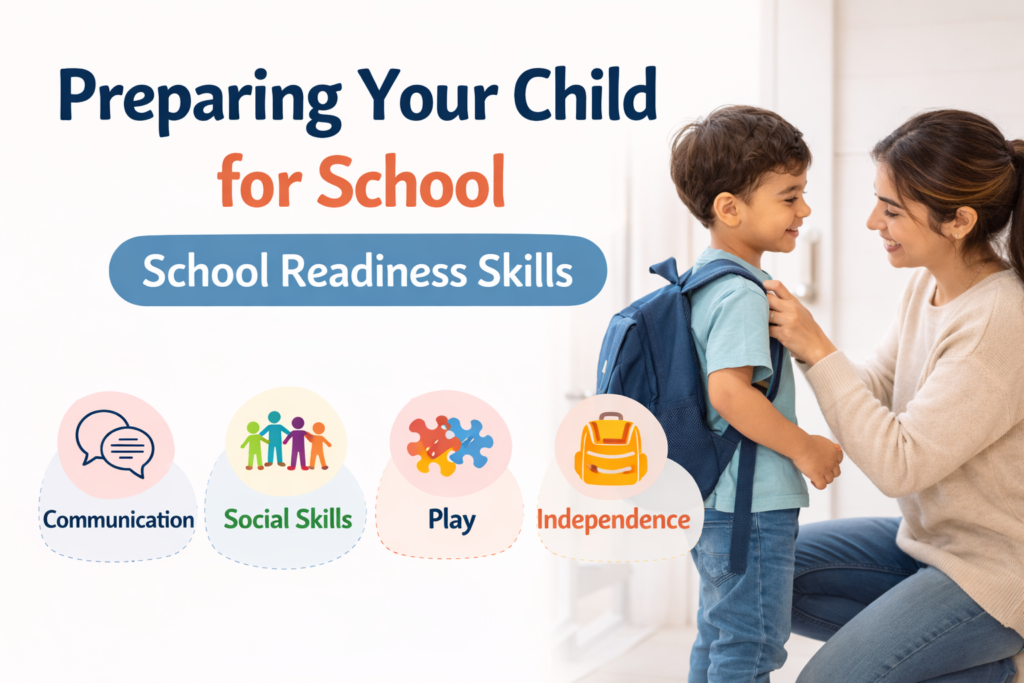
For every parent, a child’s first day of school brings a lot of mixed emotions. I remember the excitement when my daughter was about to start school—narrowing down the school, buying school supplies, reminiscing about my own school days, and sharing them with my daughter.
We parents are very excited for them to embark on this new journey, which will open the door to a bright future. At the same time, it also makes us anxious and sometimes unsure if they are ready to make this big transition from the safety and comfort of near and dear ones to this new phase. Yes, speechie moms too get these anxieties 🙂
But we all know this is unavoidable and necessary for our children to learn and develop skills that will prepare them for later stages of life. So the best we can do is prepare them with some necessary school readiness skills to help them in this transition and make this new beginning a more pleasurable experience.
So what is School Readiness?
Does it mean we need to teach our children to read and write before they start school, or is it just making them recite 1–10 or say the alphabets?
No.
By being school ready, we mean that our children:
- Have good social skills and are able to be part of a group
- Have good listening and communication skills
- Are able to follow instructions and avoid and/or cope with distractions
- Have good self-care skills, self-regulation, and confidence
It doesn’t mean that by the time children reach school they should have already mastered these skills. But preparing our children in these areas will help them transition well to school. It will help ease their anxiety while settling into the new environment and make learning a more enjoyable experience.
Imagine if our kids lacked these skills—it would not only interfere with our own child’s learning and development but also affect the entire classroom environment. For example, if a child is too sleepy, he/she won’t pay attention. Or if they do not have self-regulation (self-control), they may not be able to control their emotions, avoid distractions, and may have a hard time adjusting to the new environment.
Also, not being able to be part of a group, take turns, or share can make the child feel isolated and unhappy. Therefore, it is important for us parents to make some preparations in these areas as we get ready to start our little one’s school.
How can we help?
It can be very stressful and even intimidating to be in a new environment, say in a new job—even for us adults. So imagine how anxious our little ones would feel. Let’s look at a few things that we can do while preparing them for school, which will make them more confident and ready for this new journey.
Language Skills
Children must be able to understand what the teacher is saying and also respond in a way that can be understood by the teacher or peers. Our children may not have stayed away from their parents for an extended period of time until now, so it is very important for them to be able to clearly communicate their needs, like feeling unwell, needing to go to the toilet, or even asking the teacher to repeat instructions.
They must also be able to understand and follow simple instructions, e.g., “Take the crayons and colour the apple.” They should be able to focus by avoiding distractions and paying attention to the activity at hand.
Some orientation to early literacy skills like counting till 10, the alphabet song, and some rhymes will also be very helpful for kids when they start school.
What can be done at home
Reading Books: Read books together whenever possible.
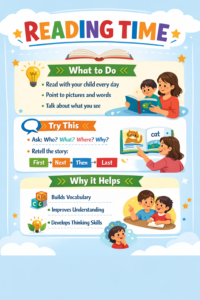
You can also encourage your child to turn pages by saying “turn the page.”These are great ways to improve vocabulary, sequencing, reasoning, and problem-solving skills.
Daily Activities for Teaching Concepts (Counting, Sorting, Describing, Matching, Location):
Simple everyday activities like setting the table or getting dressed can be turned into fun opportunities to help children learn naturally as part of daily routines.
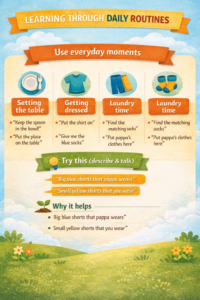
These activities help introduce simple concepts like matching, sorting, counting, and describing.
Play Time:
Games like “Simon says touch your nose” or “touch your nose and sit on the floor” help children practise following instructions. Singing rhymes and action songs also help them feel more confident to participate in classroom activities.
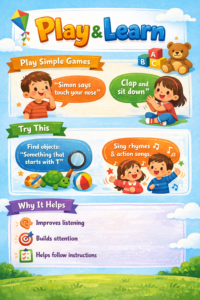
These simple play activities help improve listening, attention, and the ability to follow instructions.
Cooking and Following Simple Recipes:
Make simple recipes with your child by following steps and instructions—for example, making lemonade or assembling a sandwich.
Night Time:
Encourage children to talk about everything that happened during the day at bedtime. Ask them about their favourite part of the day and what they didn’t enjoy.
This will help in understanding tenses, sequencing, and reviewing the entire day. It will also be a great bonding time, building trust and confidence for them to share their day with you once they start school.
Social Skills
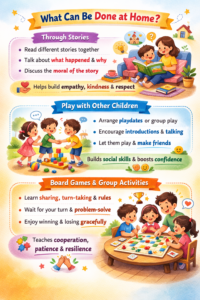
Another important aspect is the child’s ability to engage in age-appropriate play, participate in group activities, share toys, and enjoy interactions with peers.
At home, they may be used to getting things done their way, but when they are with other children, they will have to learn to wait for their turn—even in activities they enjoy. Similarly, they will have to understand that they cannot continue an activity once it is over, even if it is their favourite.
Therefore, it is important for them to understand these social rules and be able to follow them.
What can be done at home
Emotional Development
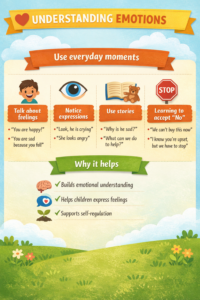
Most children are impulsive and are used to getting things done their way at home. However, at school, things may not always happen according to their wishes.
So it is very important to teach self-regulation (self-control). Children should understand acceptable behaviour—what they can and cannot do at school.
They should also learn patience and the ability to wait, understanding that others have needs too. Encourage children to accept and admit mistakes. This will help them feel more confident, less stressed, and better able to adjust.
What can be done at home
Physical and Motor Development
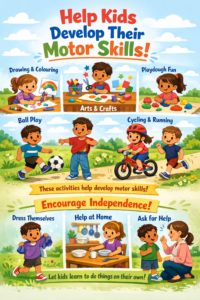
Children also need physical readiness, including motor skills like holding a pencil, buttoning, or zipping. This helps independence at school.
Personal care is also important—being toilet trained and maintaining hygiene like washing hands.
How can we help
Conclusion
Transitioning from home to school is a big step. But children are good at adapting. Soon, they get used to routines and begin to enjoy this phase.
Talk positively about school, share your experiences, and build excitement.
Every child is different, with unique strengths and learning styles. Be supportive and allow them to grow at their own pace.
If your child does not demonstrate all these skills, do not worry. Trust your instincts—you will know when your child is ready.
School readiness is not about how much a child knows, but how comfortably they can learn, interact, and adapt.
And remember… this too will pass.