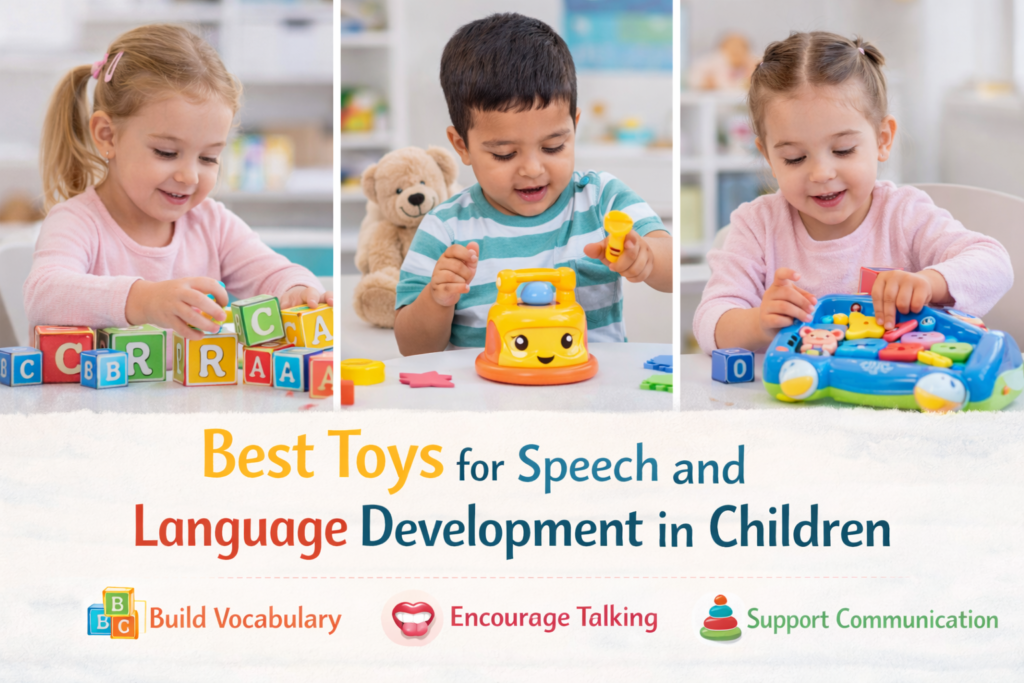
A very common question that I get quite often as an SLP is regarding suggestions on toys. Parents are always asking for recommendations on toys for language development that promote speech and language skills. A single word answer would be “SIMPLE” toys. With so many new toys in the market, many that are too sophisticated and complicated to even be called toys, it is natural for any of us to believe that the more sophisticated-looking ones may be the better ones. And so I understand why most parents are confused about selecting the right toys for their kids.
From my experience as an SLP and as a mother of two kids, I have been lucky to have a lot of opportunities to play with toys :). And believe me when I say this, the more a toy can do on its own, the fewer opportunities it gives the child to learn. This is why simple toys for language development often work much better than fancy ones. So the more fancy-looking, battery-operated toys never really made it to my kids’ toy collection unless they were gifted.
As a general criteria, we can say that toys that provide many opportunities for interactive play can be considered good ones. Providing children with the right toy keeps their attention and keeps them socially engaged. It also introduces new concepts and builds their imagination.
However, it is important to understand that it is not the toys themselves that can do all this magic. A good toy only provides opportunities to teach all this. But it is the parent who must use this opportunity to facilitate speech and language development in their child.
Why Play Therapy is Important
The benefits of play can extend far beyond linguistic skills and help in improving emotional, social, physical, and cognitive skills. Play also helps to create lasting memories. The lessons learned are remembered and may also help in making real-life improvements and improving social and communication skills.
Favourite Toys
Bubbles:
Bubbles are one of my favorite toy, especially in the rapport-building phases. They never fail to fascinate my kids and help them warm up and interact. It also works on requesting, joint attention, turn-taking, visual tracking—a variety of skills which are prerequisites for language learning.
Few words that can be introduced using bubbles are: open/shut, blow, pop, oh no, fly.
Ball:
These are another favourite that provides endless opportunities to introduce new words and encourage interaction. These are very effective for teaching turn-taking. They can be used to work on verbs like run, catch, throw, etc. While working on prepositions, they can be used to introduce words like up, down, behind, under, etc. I also use them as reinforcements in between activities by allowing kids to throw them into boxes or bins. This has always proved to be a good motivator in most instances.
Books:
Really simple picture books with 1–5 words on a page can be great for language learning. I like to read them together by pointing out the pictures and explaining what each character is doing. Using a hard/thick book will be a good idea as it will be more sturdy and easy to flip pages. Also remember, repetition is the key here.
Books can also help introduce concepts such as:
- Size concepts
- Counting
Stacking:
These are some of the first toys I bought for my own children. The reason is the versatility of these toys. They are very interactive and also last for a long time. A variety of concepts can be introduced using these toys, ranging from language, cognitive, and motor skills, etc. Some of these are:
∙ Color concepts
∙ Size concepts
∙ Shapes
∙ Counting
∙ Motor skills
∙ Turn-taking
∙ Spatial concepts (on, under, in, above, below, etc.)
∙ Creative play (pretend as cups, phones)
Puzzles:
Wooden puzzles are another favourite because of their durability and ease of manipulation, and they encourage motor skills. These are great for teaching vocabulary, requesting, categorisation, and concepts (numbers, letters, colors), etc. These toys also help foster problem solving, cognitive reasoning, and spatial awareness. These are available in varying levels of complexity. Also, if using them for younger kids, remember to use ones with pegs as they will be easier to grab.
Cars:
Most of our kids have these. Every child should have a few of these toys irrespective of whether the child is a boy or a girl. These are great for teaching many concepts, which include:
Verbs: Drive, stop, brake, race, speed, crash, etc.
Adjectives and Adverbs: Big, small, fast, slow, etc.
Spatial concepts: On, under, up, down, etc.
Color and Size Concepts
Part/Whole relationships: These toys are great for teaching this concept. We can teach different parts of a car such as wheel, window, door, etc.
Social Skills: Requesting, turn-taking, following directions, etc.
Kitchen set:
This is another favourite among kids. I believe one reason why these are such a hit among children is because of how they are connected to the real world. Most of the available fake food items and kitchen items look realistic, and that itself makes it very motivating for children to play with them. Few concepts that can be taught using these toys include:
Vocabulary/Labelling: Food items, kitchen items like kitchenware, and others like fridge, microwave, oven, stove, etc.
Verbs: Eat, cook, drink, stir, mix, etc.
Adjectives/Describing Words: Tasty, sweet, hot, cold, etc.
Important pointers while choosing a toy:
- Stay away from battery operated toys. Or if the toys are really good but makes noises, just take the battery out and you make noises instead. For eg: Those very popular animal noise making toys. Its great the way each animal pops up. But it would be way better and more enjoyable and beneficial if you made the noises instead of the machine.
- Choosing an open ended toy. Meaning toys that allows the child to use it in many ways based on their
imagination. It doesnt necessarily have a beginning , middle or end. - Developmentally Appropriate: This is very important. Consider the child’s developmaental stage while
choosing a toy. Otheerwise it may be too boring or too complicated for the child. - Durable and simple. This will allow them opputunity to play with the same toy over and over again .
Repetition is a key to learning new skills so this is very important. - Ecncourage Social Interaction oppurtunities.
- Choose toys without gender bias: Provide oppurtunities to play with a variety of toys. Girls should get
too play with cars and construction toys and boys should be allowed to play with dolls and kitchen set as
well.
What is important to remember is that it is not just the toy itself but how we use it to elicit these skills that makes the difference. It is very important to understand that even though these toys can be very beneficial for language learning, they are not a must for learning to talk. It is important not to forget that it is “you” who can become the most fun toy for the child.
It is when we play together with our children that they have the most fun. It can be any simple game like singing rhymes, making funny animal noises, dancing, hide and seek, etc. This allows us to connect with the child by gaining their interest and attention, even when using simple toys for language development during playtime.
So remember, it is actually the communication that happens during playtime with toys that is important. It is then that toys become teachers, providing endless possibilities for language learning.
These are just examples of a few toys that can be used to improve language and communication skills. I will list down a few more toys that I enjoy using with my kids on the Toy Recommendation page. You may refer to this link to check them out.